The Story Behind the Name
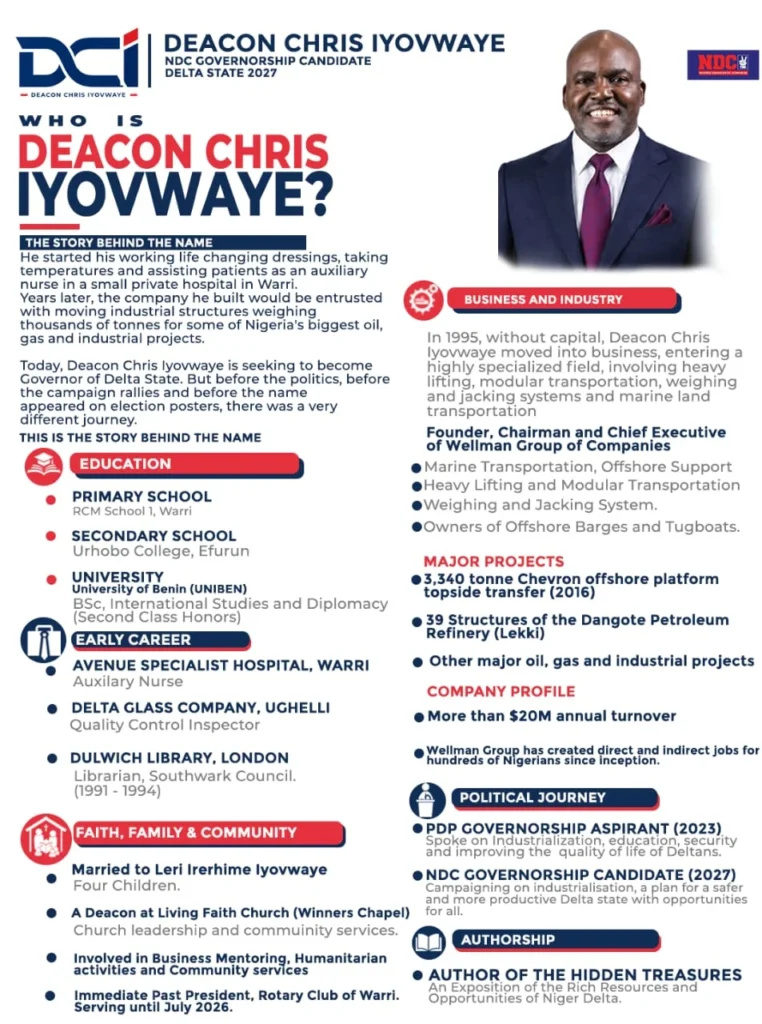
He began his career changing dressings, taking temperatures, and assisting patients as an auxiliary nurse at a small private hospital in Warri.
Years later, the company he built was entrusted with moving industrial structures weighing thousands of tonnes for some of Nigeria’s biggest oil, gas, and industrial projects.
Today, Deacon Chris Iyovwaye is seeking to become Governor of Delta State.
But before the politics, before the campaign rallies and before the name appeared on election posters, there was a very different journey.
This is the story behind the name.
From Warri
Chris Iyovwaye was born in Warri on February 24, 1964, into the family of James Iyovwaye of Aghalokpe in Okpe Local Government Area and Josephine Iyovwaye, whose family roots extend to Ekpan in Uvwie and Ewu in Ughelli South.
He began his education at RCM School 1 in Warri and later attended Urhobo College, Effurun. He subsequently studied International Studies and Diplomacy at the University of Benin, where he graduated with Second Class Honors.
His professional journey did not begin in oil and gas.
It began in healthcare.
As a young man, Iyovwaye worked as an auxiliary nurse at Avenue Specialist Hospital in Warri. He later joined Delta Glass Company in Ughelli as a Quality Control Inspector.
Between 1991 and 1994, he also worked as a librarian at Dulwich Library under Southwark Council in London.
Nursing. Quality control. Library services.
None of those jobs looked like an obvious route into heavy industry.
But they formed the early chapters of a career that would eventually take a very different direction.
Starting From Zero
In 1995, Iyovwaye moved into business.
He has often described that beginning: he started with no capital.
What followed was not a conventional trading business.
Iyovwaye entered a highly specialized field involving heavy lifting, modular transportation, weighing and jacking systems, and marine and land transport.
In simple terms, his company developed the capability to move things that ordinary trucks and conventional lifting systems cannot move — refinery components, offshore structures, heavy industrial equipment and other oversized cargo.
The business grew into what became the Wellmann Group of Companies.
Published profiles describe Wellmann as operating across marine transportation, offshore support, heavy lifting, supply-chain services and other industrial activities. Iyovwaye remains closely associated with the company’s growth from a small indigenous enterprise to an operator capable of handling complex industrial logistics.
Recently published accounts, citing Wellmann’s own figures, say the company generates more than $20 million in annual turnover and employs about 75 people.
These are company-reported figures, not publicly available audited accounts.
But the more easily documented part of Wellmann’s story is the work itself.
Building Nigerian Industrial Capacity
Wellmann’s development coincided with Nigeria’s increasing emphasis on indigenous participation in the oil and gas industry.
Iyovwaye has consistently presented himself as an advocate of Nigerian Content—the principle that Nigerian businesses should develop the technical capability, equipment, and expertise needed to participate meaningfully in major projects within the country.
For him, Nigerian Content was not simply about ownership.
It was about proving that a Nigerian company could acquire the equipment, people and technical capacity required to compete in difficult areas of industrial operations.
That proposition would eventually be tested on major projects.
The 3,340-Tonne Chevron Operation
One of the clearest examples came in 2016.
Wellmann helped transfer a massive offshore platform topside built by Nigerdock for Chevron.
The structure weighed approximately 3,340 tonnes.
According to Offshore Magazine, the operation involved four groups of synchronised modular trailers comprising 128 axle lines.
The topside had to be lifted from its fabrication foundations, carefully moved towards the jetty and progressively rolled onto a ballasted barge. At the same time, engineers adjusted the barge’s ballast as the enormous load moved aboard.
It was not simply a matter of having large equipment.
The operation required engineering, planning, coordination and precision.
Iyovwaye has separately referred in interviews to moving a 3,800-tonne cargo in connection with Chevron’s Meren project. Because published accounts contain different tonnage figures, the independently documented 3,340-tonne operation remains the clearest external reference for the scale of the work.
For a Nigerian-owned business operating in a highly specialised field, it was a significant industrial undertaking.
Then Came Dangote
Another major chapter in the Wellmann story came during the development of the Dangote Petroleum Refinery in Lekki.
The refinery required moving enormous pieces of industrial machinery and equipment.
Iyovwaye told Bird Story Agency that Wellmann competed for logistics work on the project and was the only indigenous Nigerian company among foreign operators handling specialized logistics.
He also said Wellmann helped move 39 structures connected with the project.
Whether in Chevron’s offshore operations or at the Dangote Refinery, the underlying story was similar:
A business that began in Warri had developed the capacity to participate in some of Nigeria’s most technically demanding industrial projects.
More Than Business
There is another side to Iyovwaye’s public identity.
He is a Deacon at Living Faith Church, also known as Winners Chapel, and has held leadership responsibilities within the church.
He has also been involved in business mentoring, humanitarian activities, and community service.
He is married to Leri Irerhime Iyovwaye, and they have four children.
Those who know him through business therefore know an industrialist.
Those who know him through church know the Deacon.
And those who have followed Delta politics know another part of the story.
The Move Into Politics
Iyovwaye’s first major attempt to become Governor of Delta State came ahead of the 2023 election.
In 2022, he sought the Peoples Democratic Party governorship ticket.
At the time, he spoke publicly about industrialisation, education, security and improving the quality of life of Deltans.
He did not win the PDP governorship primary. Sheriff Oborevwori emerged as the party’s candidate, and Iyovwaye subsequently congratulated him.
Four years later, Iyovwaye returned to the governorship contest on a different political platform.
Today, he is the Nigeria Democratic Congress (NDC) Governorship Candidate for Delta State 2027. His candidacy and the NDC campaign structure have since moved into statewide political activity ahead of the election.
His campaign presents its policy programme under Delta Vision 2035, with proposals spanning economic development, security, infrastructure, education, healthcare, agriculture, industrial development, technology and other sectors.
But before discussing those plans, a more fundamental question remains about the candidate himself.
So, Who Is Deacon Chris Iyovwaye?
He is the young man who began as an auxiliary nurse in Warri.
The nurse who became a quality-control inspector.
The quality-control inspector who became an entrepreneur.
The entrepreneur who built a Nigerian industrial-services business that would eventually help move structures weighing thousands of tonnes.
And the industrialist who has now entered public life and is asking Deltans to examine whether the discipline, systems, problem-solving, and execution required in his private-sector career apply to the governance of Delta State.
Deltans must ultimately answer that question.
But understanding where he came from, what he has done, and the experiences that shaped him is the first step towards understanding the candidate.
Because knowing who Deacon Chris Iyovwaye is leads naturally to the next question:
WHY IS HE RUNNING?
Next in the series: Why I Am Running — Deacon Chris Iyovwaye on the Delta he sees, the problems he believes must be addressed, and why he has chosen to seek public office.